How to Import Medium Voltage Power Cables: Certifications and Compliance
Importing medium voltage (MV) power cables, rated from 6 kV to 35 kV per IEC 60038, requires strict adherence to certifications and compliance requirements to ensure safety, quality, and market access. These cables are used in industrial, utility, and infrastructure projects, and non-compliance can lead to customs rejections, project delays, or safety risks.
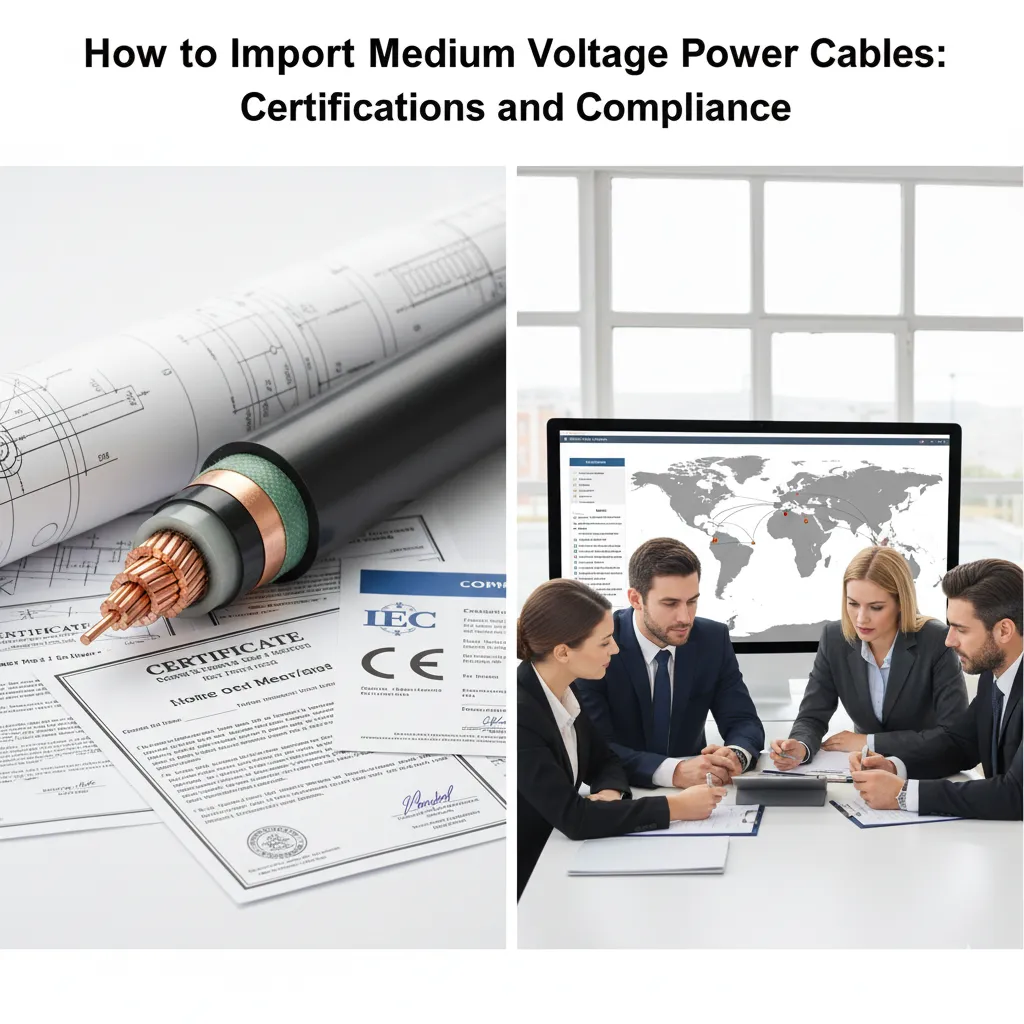
Table of Contents
1. Overview of MV Power Cable Import
Importing MV power cables involves sourcing from manufacturers, verifying compliance with international and destination-specific standards, and navigating customs procedures. MV cables, often featuring XLPE insulation, copper or aluminum conductors, and steel wire armoring (SWA), must meet rigorous requirements for electrical performance (e.g., insulation resistance >1000 MΩ/km), safety (e.g., flame-retardant per IEC 60332-3), and environmental resistance. Jianyun Cable provides TUV- and CCC-certified MV cables, ensuring reliability for global import projects.
2. Key Certifications for MV Power Cables
Certifications verify that MV cables meet safety and performance standards, facilitating import and market acceptance. Key certifications include:
- IEC 60502-2: International standard for MV cables (6–30 kV) with extruded insulation (e.g., XLPE), covering construction, testing (partial discharge <10 pC), and performance.
- TUV Certification: Issued by TUV Rheinland, verifies compliance with IEC 60502-2, EN 50618, and other standards; essential for Europe and global markets.
- CCC (China Compulsory Certification): Mandatory for cables manufactured in China, ensuring compliance with GB/T 12706 (aligned with IEC 60502).
- UL Certification: UL 1072 for MV cables in North America, confirming safety and flame-retardant properties.
- CE Marking: Required for Europe, indicating compliance with EU directives like Low Voltage Directive (LVD) and RoHS.
- RoHS/REACH: Restricts hazardous substances; mandatory for EU markets and increasingly required globally.
- Example: Jianyun Cable’s 11 kV XLPE-insulated MV cables are TUV- and CCC-certified, compliant with IEC 60502-2.
| Certification | Region | Details |
|---|---|---|
| IEC 60502-2 | Global | MV cable construction, testing, performance. |
| TUV | Europe/Global | Third-party verification for IEC, EN standards. |
| CCC | China | Mandatory for Chinese-manufactured products. |
| UL 1072 | North America | Safety and flame-retardant for MV cables. |
| CE Marking | Europe | Compliance with LVD, RoHS directives. |
3. Step-by-Step Import Process
Importing MV power cables involves several steps to ensure compliance and smooth customs clearance:
- Identify Requirements:
- Determine cable specifications (e.g., 12/20 kV, XLPE-insulated, SWA-armored).
- Research destination regulations (e.g., UL 1072 for US, CE for Europe).
- Select a Supplier:
- Choose manufacturers like Jianyun Cable with TUV/CCC certifications and export experience.
- Verify supplier credentials via Alibaba or Made-in-China reviews (≥97% positive feedback).
- Verify Certifications:
- Request certificates and test reports (e.g., partial discharge <10 pC, insulation resistance >1000 MΩ/km).
- Validate through official databases (e.g., TUV Certipedia, UL Product iQ).
- Place Order and Prepare Documentation:
- Include HS codes (e.g., 8544.60 for >1 kV insulated cables) in the Proforma Invoice.
- Prepare CoC, DoC, test reports, and bill of lading.
- Arrange Shipping:
- Use sea freight for bulk orders; ensure ISPM 15-compliant wooden drums.
- Partner with freight forwarders (e.g., DHL, FedEx) for logistics.
- Clear Customs:
- Submit documentation to customs; pay duties (e.g., 5–10% in Europe).
- Ensure compliance with RoHS/REACH for hazardous substances.
- Conduct Post-Import Testing:
- Test for insulation integrity and voltage drop upon receipt.
| Step | Action |
|---|---|
| Identify Requirements | Determine specs, research regulations. |
| Select Supplier | Choose certified manufacturers like Jianyun Cable. |
| Verify Certifications | Request reports, validate via databases. |
| Place Order | Include HS codes, prepare documents. |
| Arrange Shipping | Use sea freight, ISPM 15 drums. |
| Clear Customs | Submit CoC, pay duties. |
| Post-Import Testing | Test insulation, voltage drop. |
4. Regional Compliance Requirements
Compliance varies by region, with key requirements including:
- Europe: CE marking under Low Voltage Directive (LVD), CPR for construction products (EN 50575), RoHS/REACH for hazardous substances. TUV certification is highly regarded.
- North America: UL 1072 for MV cables, CSA for Canada; NFPA 70 (NEC) for installation.
- Middle East: G-Mark (GCC), SABER (Saudi Arabia), ECAS (UAE); compliance with IEC 60502-2 and local standards (e.g., SASO/IEC).
- China (for Export from China): CCC mandatory for Chinese manufacturers; align with GB/T 12706 (equivalent to IEC 60502).
- Other Regions: SII (Israel), COI (Iran), CoC (Iraq); verify via local regulatory bodies.
| Region | Key Certifications | Standards |
|---|---|---|
| Europe | CE, TUV | LVD, CPR, RoHS/REACH |
| North America | UL 1072, CSA | NFPA 70 (NEC) |
| Middle East | G-Mark, SABER, ECAS | IEC 60502-2, SASO/IEC |
| China (Export) | CCC | GB/T 12706 |
5. Challenges and Solutions
| Challenge | Solution |
|---|---|
| Regulatory Variations | Partner with consultants (e.g., Intertek) for market-specific guidance; use dual-certified cables (e.g., TUV/IEC). |
| Counterfeit Certifications | Verify via official databases (e.g., TUV Certipedia); source from Jianyun Cable with authentic TUV/CCC. |
| Customs Delays | Prepare complete documentation (CoC, test reports); use experienced forwarders (e.g., DHL). |
| High Costs | Negotiate bulk discounts; use aluminum conductors for non-critical runs if compliant. |
| Quality Issues | Request samples and third-party testing; perform post-import inspections. |
6. Conclusion
Importing medium voltage power cables requires a structured approach to certifications (e.g., IEC 60502-2, TUV, CCC) and compliance (e.g., RoHS/REACH, CE) to ensure safety and market access. By identifying requirements, selecting certified suppliers like Jianyun Cable, verifying documents, and navigating customs, importers can achieve successful outcomes. Regional variations (e.g., SABER for Saudi Arabia, UL for North America) necessitate tailored strategies. Addressing challenges like regulatory differences and counterfeit products through verification and partnerships ensures reliable MV cables for industrial, utility, and infrastructure projects, supporting a lifespan of 25–30 years.
Source: JianYunCable.


Comments
Post a Comment