Common Faults in Medium Voltage Cables and How to Prevent Them
Medium voltage (MV) power cables, rated from 6 kV to 35 kV per IEC 60038, are susceptible to faults that can lead to system failures, safety hazards, or costly downtime. Common faults arise from insulation issues, mechanical damage, or installation errors. Understanding these faults and implementing preventive measures is essential for ensuring cable reliability and a lifespan of 25–30 years.
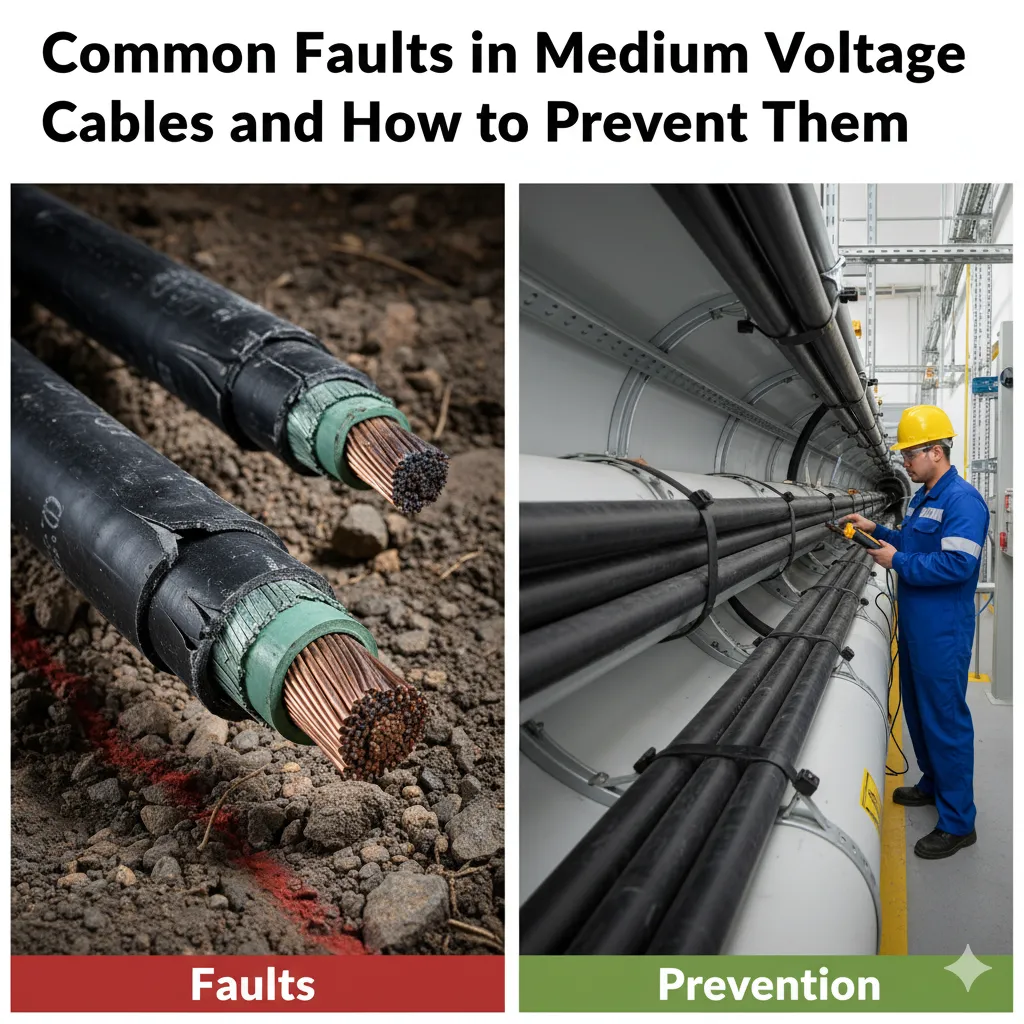
Table of Contents
1. Overview of MV Cable Faults
MV cable faults occur due to defects in insulation, conductors, or joints, often resulting from environmental stress, improper installation, or manufacturing issues. Faults can cause insulation breakdown, partial discharge, or short circuits, leading to outages or fires. Early detection and prevention, guided by standards like IEC 60502-2 and IEEE 400, are crucial. Jianyun Cable’s TUV-certified MV cables minimize faults through robust XLPE insulation and shielding, ensuring reliability in industrial applications.
2. Common Faults in MV Cables
The most common MV cable faults include:
2.1. Insulation Breakdown
- Causes: Thermal overload (>90°C for XLPE), moisture ingress, or electrical stress (e.g., surges).
- Indicators: Low insulation resistance (<100 MΩ/km), partial discharge (>10 pC).
- Example: Moisture in underground cables causes water treeing, reducing dielectric strength.
2.2. Partial Discharge
- Causes: Voids or defects in insulation (e.g., XLPE), poor jointing, or contamination.
- Indicators: PD levels >10 pC at 1.73 × U₀ (e.g., 10.4 kV for 6/10 kV cable).
- Example: Installation defects in mining projects lead to progressive insulation failure.
2.3. Joint and Termination Failures
- Causes: Improper assembly, loose connections, or corrosion at terminations.
- Indicators: Overheating at joints, arcing, or burn marks.
- Example: Poor crimping in oil and gas facilities causes overheating.
2.4. Mechanical Damage
- Causes: Impact, crushing, or excessive bending during installation or operation.
- Indicators: Insulation punctures or conductor breaks, detected by continuity tests.
- Example: Rockfalls in mining damage unarmored cables.
2.5. Sheath and Armor Corrosion
- Causes: Exposure to moisture, chemicals, or soil acidity in underground installations.
- Indicators: Reduced sheath integrity, leading to moisture ingress and insulation failure.
- Example: Chemical exposure in refineries corrodes SWA armoring.
3. Prevention Strategies
Preventing MV cable faults requires proactive measures:
- Proper Cable Selection: Choose XLPE-insulated cables (90°C max) for high-temperature applications; SWA-armored for mechanical protection (e.g., Jianyun Cable’s 11 kV SWA-armored XLPE cable).
- Thermal Management: Apply derating factors (e.g., 0.91 at 40°C per IEC 60364) to avoid overload; use heat-dissipating cable trays.
- Moisture Protection: Seal cable ends with heat-shrink caps; use water-blocking tapes in underground cables.
- Installation Best Practices: Maintain bending radii (6–10D); use proper jointing kits (e.g., cold-shrink) and trained personnel.
- Environmental Protection: Use PUR or LSZH sheathing for chemical or fire-prone areas; apply anti-corrosion coatings for armor.
| Fault | Cause | Prevention |
|---|---|---|
| Insulation Breakdown | Thermal overload, moisture | XLPE insulation, water-blocking tapes, derating. |
| Partial Discharge | Insulation voids, poor jointing | Proper jointing kits, PD testing (<10 pC). |
| Joint Failures | Loose connections, corrosion | Heat/cold-shrink kits, anti-corrosion compounds. |
| Mechanical Damage | Impact, crushing | SWA armoring, conduits for protection. |
| Corrosion | Moisture, chemicals | Galvanized SWA, PUR sheathing, sealed ends. |
4. Testing and Monitoring Techniques
Regular testing detects potential faults early:
- Insulation Resistance Test: Measure >1000 MΩ/km at 20°C using a 5 kV megger to detect degradation.
- Partial Discharge Test: Monitor <10 pC at 1.73 × U₀ (e.g., 10.4 kV for 6/10 kV) per IEC 60502-2.
- Time Domain Reflectometry (TDR): Locate mechanical faults or insulation defects.
- Thermal Imaging: Identify hotspots from overloading or poor connections.
- Sheath Integrity Test: Apply 5 kV DC to detect corrosion or damage.
- Periodic Maintenance: Conduct annual inspections and tests, especially for underground cables.
| Test | Details |
|---|---|
| Insulation Resistance | >1000 MΩ/km at 20°C |
| Partial Discharge | <10 pC at 1.73 × U₀ |
| TDR | Locate faults |
| Thermal Imaging | Detect hotspots |
| Sheath Integrity | 5 kV DC test |
5. Standards and Compliance
MV cables must comply with international standards to ensure fault prevention:
- IEC 60502-2: Specifies construction, insulation (e.g., XLPE), and testing for MV cables (6–30 kV).
- IEEE 400: Guidelines for field testing, including PD and insulation resistance.
- IEC 60332-3: Flame-retardant properties for bundled cables.
- IEC 60038: Voltage classification (e.g., 6/10 kV).
- Regional Standards: Comply with CCC (China), CE (Europe), or UL (North America) for project-specific requirements.
- Certifications: Jianyun Cable provides TUV, CCC, and ISO 9001-certified MV cables.
| Standard | Details |
|---|---|
| IEC 60502-2 | MV cable construction, testing |
| IEEE 400 | Field testing guidelines |
| IEC 60332-3 | Flame-retardant properties |
| IEC 60038 | Voltage classification |
6. Challenges and Solutions
| Challenge | Solution |
|---|---|
| Detecting Early Faults | Implement PD monitoring and insulation tests; use Jianyun Cable’s high-quality XLPE cables. |
| Installation Errors | Train personnel on jointing; maintain bending radii (6–10D). |
| Environmental Exposure | Use SWA-armored cables; apply anti-corrosion coatings. |
| Counterfeit Cables | Source from Jianyun Cable with TUV/CCC certifications; verify via databases. |
| Regulatory Non-Compliance | Confirm compliance with IEC 60502-2 and regional standards (e.g., G-Mark for GCC). |
7. Conclusion
Common faults in medium voltage cables—insulation breakdown, partial discharge, joint failures, mechanical damage, and corrosion—can be prevented through proper cable selection (e.g., XLPE insulation, SWA armoring), thermal management, and environmental protections. Regular testing (e.g., PD, insulation resistance) and compliance with standards like IEC 60502-2 ensure long-term reliability. Henan Province Jianyun Cable Co., Ltd. offers TUV-certified MV cables designed to minimize faults, providing robust solutions for industrial applications. By implementing these strategies, users can achieve safe, efficient power systems with a lifespan of 25–30 years.
Source: JianYunCable.


Comments
Post a Comment