Process Improvement in Volume Resistivity Detection of Semi-Conductive Shield for Large-Scale Cables
Introduction
The volume resistivity of semi-conductive shields plays a crucial role in determining the electrical performance of high-voltage cables. These shields help regulate electric field distribution, reduce partial discharge, and enhance insulation stability. However, traditional detection methods for large-scale cables suffer from several challenges:
✔ Manual sample preparation results in uneven surfaces, leading to inconsistent test data.
✔ Low testing efficiency makes large-scale quality control difficult.
✔ Current resistivity measurement techniques lack precision, particularly for high-resistance samples.
This study proposes an improved testing process using large-scale cutting machines, fixed mold techniques, and copper sheet molds to enhance the accuracy and reliability of volume resistivity detection for semi-conductive shields in large-diameter cables (64/110 kV and above).
1. Key Challenges in Current Testing Methods
1.1 Sample Preparation Issues
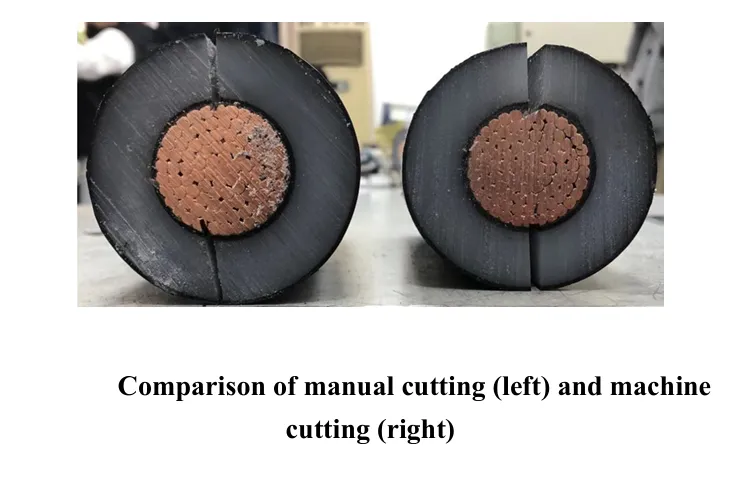
Large-diameter cables require precise sample preparation, but manual cutting methods introduce several problems:
- Irregular sample surfaces → Affects contact between electrodes and sample.
- Low efficiency → Time-consuming manual operations slow down testing.
- High rejection rates → Errors in cutting lead to wasted samples.
| Factor | Manual Cutting | Large-Scale Cutting Machine |
|---|---|---|
| Surface Quality | Rough, uneven | Smooth, precise |
| Cutting Time | Long (5–10 min per sample) | Short (1–2 min per sample) |
| Safety | Risk of hand injuries | Controlled cutting process |
➡ Conclusion: Upgrading to large-scale cutting machines significantly improves efficiency and safety.
1.2 Problems in Volume Resistivity Measurement
A. Conductor Shield Resistivity Testing Issues
Traditional conductive paste coating method for resistivity testing suffers from:
- Long curing times (12+ hours at room temperature).
- Electrode damage due to sharp contact points.
B. Insulation Shield Resistivity Testing Issues
The self-adhesive copper tape method, commonly used for insulation shields, has drawbacks:
- Weak adhesion at high temperatures (90°C) → Copper tape falls off.
- Uneven contact with the sample, causing measurement errors.
➡ Conclusion: A more stable and repeatable resistivity testing process is needed.
2. Proposed Process Improvements
2.1 Upgraded Sample Preparation Method
Large-scale cutting machines were introduced to replace manual cutting, ensuring smooth, uniform sample surfaces.
➡ Effect: Increased efficiency, improved cutting accuracy, and reduced sample waste.
2.2 Improved Volume Resistivity Testing Techniques
A. Copper Sheet Mold Method (Replacing Conductive Paste Method)
✔ Pre-fabricated copper sheet molds ensure stable contact with the sample.
✔ Eliminates long curing times, improving testing speed.
B. Fixed Mold Method (Replacing Self-Adhesive Copper Tape Method)
✔ Uses a tight-fit mold to secure copper electrodes against the sample.
✔ Prevents detachment at high temperatures, ensuring reliable data collection.
| Method | Advantages | Replaced Method |
|---|---|---|
| Copper Sheet Mold | Fast, repeatable, high accuracy | Conductive paste method |
| Fixed Mold | No adhesive issues, stable contact | Self-adhesive copper tape |
➡ Effect: Enhanced measurement consistency, reducing error rates.
3. Experimental Validation and Results
3.1 Sample Quality Comparison
| Cutting Method | Surface Smoothness | Preparation Time |
|---|---|---|
| Manual Cutting | Uneven | ~10 min/sample |
| Large-Scale Cutting | Smooth | ~2 min/sample |
➡ Key Finding: Automated cutting ensures smoother samples and faster preparation.
3.2 Volume Resistivity Test Results
Tested on 64/110 kV cables with different cross-sectional areas:
A. Conductor Shield Resistivity Results
| Method | Volume Resistivity (Ω·m) after Heating |
|---|---|
| Conductive Paste | 6.62 (0.5h) → 5.90 (1.5h) |
| Copper Sheet Mold | 5.91 (0.5h) → 5.66 (1.5h) |
➡ Copper sheet method consistently produced lower and more stable resistance values.
B. Insulation Shield Resistivity Results
| Method | Volume Resistivity (Ω·m) after Heating |
|---|---|
| Self-Adhesive Copper Tape | 5.69 (0.5h) → 1.82 (1.5h) |
| Fixed Mold | 1.71 (0.5h) → 1.69 (1.5h) |
➡ Fixed mold method significantly reduced resistance fluctuations, ensuring measurement accuracy.
4. Engineering Insights and Industry Implications
4.1 Impact on Quality Control
✔ Higher repeatability → Eliminates sample variation.
✔ Reduced testing time → Increases productivity in manufacturing QC labs.
4.2 Economic and Industrial Benefits
| Aspect | Improvement |
|---|---|
| Production Efficiency | +30% faster testing cycle |
| Testing Cost | -20% material waste reduction |
| Compliance with Standards | Meets GB/T 11017.1-2014 requirements |
➡ Manufacturers can improve efficiency while maintaining high-quality standards.
5. Conclusion and Recommendations
5.1 Summary of Key Improvements
✔ Large-scale cutting machines enhance sample preparation efficiency.
✔ Copper sheet molds eliminate inconsistencies in conductor shield resistivity testing.
✔ Fixed mold technique ensures reliable insulation shield resistivity measurement.
5.2 Future Research Directions
- AI-driven automation for real-time defect detection.
- Advanced materials for better shield conductivity and stability.
- Integration with smart monitoring systems for in-line testing.
Final Verdict: These improvements enhance testing accuracy and efficiency, making them highly beneficial for large-scale cable manufacturers.
Keywords
- Large-Scale Cables
- Semi-Conductive Shield
- Volume Resistivity Testing
- High-Voltage Power Cables
- Quality Control in Cable Manufacturing
References
- Li Mei (2025). Process Improvement in Volume Resistivity Detection of Semi-Conductive Shield for Large-Scale Cables. Wire & Cable, 68(1), 55-60. DOI: 10.16105/j.dxdl.1672-6901.20240095
- GB/T 11017.1-2014 – Test Methods for High Voltage Power Cable Shielding
- GB/T 3048.3-2007 – Electrical Performance Testing of Semi-Conductive Materials


Comments
Post a Comment