Underground vs. Overhead Medium Voltage Cables: Pros and Cons
Medium voltage (MV) cables, rated from 6 kV to 35 kV per IEC 60038, are essential for power distribution in industrial, utility, and infrastructure projects. The choice between underground and overhead installations significantly impacts cost, reliability, and maintenance. Underground cables are buried in trenches or ducts, while overhead cables are mounted on poles or towers.
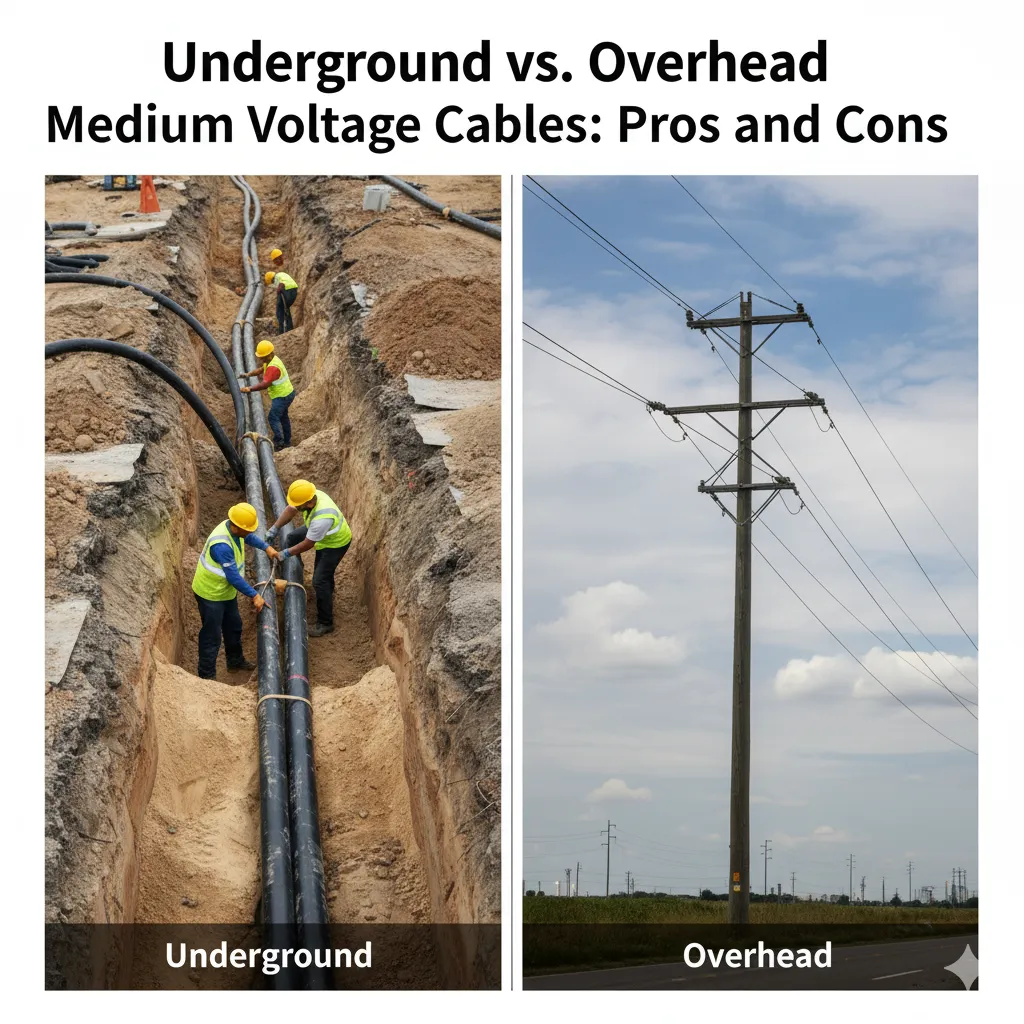
Table of Contents
1. Overview of Underground and Overhead MV Cables
Medium voltage cables are designed for efficient power transmission in applications requiring higher capacity than low voltage systems. Underground MV cables are buried in trenches or ducts, protected from weather but more complex to install. Overhead MV cables are suspended on poles or towers, exposed to elements but easier to maintain. Both types feature robust insulation (e.g., XLPE), shielding (e.g., copper tape), and armoring (for underground). Henan Province Jianyun Cable Co., Ltd. offers TUV- and CCC-certified MV cables for both underground and overhead use, ensuring compliance with IEC 60502-2.
2. Pros and Cons of Underground MV Cables
Pros
- Aesthetic Appeal: Buried cables are invisible, preserving landscape aesthetics in urban or sensitive areas.
- Protection from Weather: Shielded from storms, wind, and wildlife, reducing outage risks from external damage.
- Reduced Electrocution Risk: Less exposure to downed lines, enhancing public safety.
- Longer Lifespan: Protected from UV and temperature fluctuations, lasting 25–30 years.
- Example: Jianyun Cable’s 11 kV XLPE-insulated, SWA-armored underground cable for urban power distribution.
Cons
- Higher Installation Cost: Requires trenching and backfilling, 5–10 times more expensive than overhead.
- Difficult Maintenance: Fault location and repairs involve excavation, leading to longer downtime (e.g., 2–3 days vs. hours for overhead).
- Susceptible to Moisture/Corrosion: Requires water-blocking and corrosion-resistant sheathing to prevent insulation breakdown.
- Heat Dissipation Issues: Buried cables have lower ampacity due to poor ventilation, requiring derating (e.g., 0.85 factor per IEC 60364).
3. Pros and Cons of Overhead MV Cables
Pros
- Lower Cost: Cheaper to install and maintain, with costs 20–50% lower than underground.
- Easier Repairs: Accessible for quick fault detection and fixes, minimizing downtime.
- Better Heat Dissipation: Air cooling allows higher current capacity without derating.
- Flexible Routing: Easier to adjust for terrain or expansion.
- Example: Jianyun Cable’s 11 kV aerial bundle cable (ABC) for overhead distribution.
Cons
- Aesthetic Issues: Visible poles and wires can detract from urban landscapes.
- Vulnerable to Weather: Prone to damage from storms, wind, or wildlife, causing outages.
- Safety Risks: Higher electrocution risk from downed lines or tree contact.
- EMI Interference: Exposed cables may cause or be affected by electromagnetic interference.
4. Comparison Table
| Aspect | Underground MV Cables | Overhead MV Cables |
|---|---|---|
| Cost | Higher installation (5–10x overhead) | Lower (20–50% savings) |
| Maintenance | Difficult, longer downtime | Easier, quicker repairs |
| Environmental Protection | High (weather-resistant) | Low (exposed to storms) |
| Aesthetics | High (invisible) | Low (visible poles/wires) |
| Heat Dissipation | Lower (requires derating) | Higher (air cooling) |
| Safety | Higher (reduced electrocution risk) | Lower (downed lines) |
| EMI | Lower (buried) | Higher (exposed) |
| Lifespan | 25–30 years (protected) | 20–25 years (exposed) |
| Example Product | Jianyun Cable’s 11 kV XLPE-insulated underground cable. | Jianyun Cable’s 11 kV aerial bundle cable (ABC). |
5. Applications and Selection Criteria
Underground and overhead MV cables are selected based on project needs:
- Underground Cables:
- Applications: Urban power distribution, mining operations, airport runways, industrial plants where aesthetics or protection is prioritized.
- Selection Criteria: Use SWA-armored XLPE cables for moisture and mechanical resistance; calculate derating for soil thermal resistivity (<1.2 K·m/W).
- Example: Jianyun Cable’s 18/30 kV underground cable for urban grids.
- Overhead Cables:
- Applications: Rural utility lines, renewable energy farms, or areas with minimal aesthetic concerns.
- Selection Criteria: Use aerial bundle cables (ABC) for weather resistance; ensure proper sag (1–2% of span length).
- Example: Jianyun Cable’s 12/20 kV ABC for renewable energy integration.
Criteria: Evaluate cost (underground higher), maintenance (overhead easier), safety (underground safer), and environmental impact (underground more protected).
6. Challenges and Solutions
| Challenge | Solution |
|---|---|
| High Underground Cost | Use overhead for rural or low-density areas; optimize trench design (e.g., 0.8–1.2 m depth). |
| Overhead Weather Vulnerability | Use insulated aerial bundle cables (ABC) with UV-resistant sheathing; implement storm-resistant supports. |
| Underground Maintenance Delays | Install pull boxes and use fault location tools (e.g., TDR); plan for spare ducts. |
| Counterfeit Products | Source from Jianyun Cable with TUV/CCC certifications; verify via official databases. |
| EMI in Sensitive Areas | Use shielded underground cables; separate from low-voltage lines (150–300 mm). |
7. Conclusion
Underground and overhead medium voltage cables (6–35 kV) offer distinct advantages for power distribution: underground for aesthetics, safety, and weather protection, and overhead for cost savings, easier maintenance, and better heat dissipation. Underground cables are ideal for urban, mining, and airport applications, while overhead cables suit rural utilities and renewable energy projects. Henan Province Jianyun Cable Co., Ltd. provides TUV- and CCC-certified MV cables for both methods, ensuring reliability and compliance with IEC 60502-2. By evaluating cost, safety, maintenance, and environmental factors, and partnering with trusted suppliers, projects can achieve efficient, safe, and durable power systems lasting 20–30 years.
Source: JianYunCable.


Comments
Post a Comment